



Consolidation Testing Basics
- October 22nd, 2025
- Category: Guest Posts
Consolidation Testing Basics
Consolidation testing is one of the most popular geotechnical tests performed in the United States. It is used to determine how soils compress over time while under a constant load, and how they expel pore water during this settlement. Consolidation testing helps geotechnical engineers evaluate how a soil compresses under load and how this will affect structural settlement over time. The data obtained is crucial for the safe and reliable design of foundations and earth structures. This test is essential for understanding how soil will behave under the weight of structures like buildings, roads, embankments, or dams.
Main Objectives of Testing
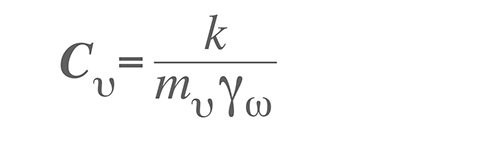
Consolidation testing predicts how much, and how fast, a soil settles when subjected to a specific load. It also helps in estimating the total and differential settlement of foundations and other weight- and pressure-bearing structures. Determining the Coefficient of Consolidation (Cv) is a key parameter in consolidation soil testing, as it plays a central role in understanding, as well as predicting, how quickly a soil will settle under a given load. The Coefficient of Consolidation (Cv) quantifies the “Rate” at which excess pore water pressure dissipates from a saturated soil layer when subjected to a load. It combines three key soil properties to determine how fast consolidation happens.
• k = coefficient of permeability (rate of water flow through soil)
• mυ = coefficient of volume compressibility (soil’s tendency to decrease in volume under pressure)
• γω = unit weight of water
Why is this Important?
Settlement time depicts the extent a soil will ultimately settle. Here’s a breakdown of its significance and why it matters in geotechnical engineering:
Calculate the Coefficient of Consolidation (Cv)
This indicates the rate at which pore water is expelled. This is important for estimating how long consolidation (settlement) will take.
Obtain the Compression Index (Cc) and Recompression Index (Cr)
Used to calculate primary consolidation settlement (Cc) and recompression due to unloading and reloading (Cr).
Identify Overconsolidation Ratio (OCR)
Tells whether the soil has been subjected to higher pressures in the past than it is currently experiencing. Helps determine whether the soil is normally consolidated or overconsolidated.
ASTM Standards Used for Consolidation Testing
ASTM D2435
Standard Test Methods for One-Dimensional Consolidation Properties of Soils Using Incremental Loading
This test is used to determine the magnitude and rate of consolidation of soil when it is restrained laterally and drained axially while subjected to incrementally applied controlled-stress loading. Two alternative procedures are provided as follows:
Test Method A — Method A is performed with a constant load incremental duration of 24 hours. This time can be extended by adding additional increments of 24 hours. For Time-deformation readings, a minimum of two load increments is required.
Test Method B — Method B requires readings on all load increments. Successive load increments are applied after 100% primary consolidation is achieved, or in constant time increments as described in Test Method A.
ASTM D4546
Standard Test Methods for One-Dimensional Swell or Collapse of Soils
Measured wetting-induced swell/collapse strains can be used to develop estimates of heave or settlement of a confined soil profile. It can also be used to estimate the magnitude of the swell pressure and the free swell strain (percent swell under a pressure of 1 kPa (20 lbf/ft2)). The load-induced strains after wetting from Test Method C can be used to estimate stress-induced settlement following wetting-induced heave or settlement. Selection of test method, loading, and inundation sequences should, as closely as possible, simulate field conditions, as relatively small variations in density and water content, or sequence of loading and wetting can significantly alter the test results.
Test Method A — Method A is a procedure for measuring one-dimensional, wetting-induced swell or hydrocompression (collapse) of reconstituted specimens simulating field condition of compacted fills. The magnitude of swell pressure (the minimum vertical stress required to prevent swelling) and free swell (percent swell under a pressure of 1 kPa or 20 lbf/ft2) can also be determined from the results of Test Method A.
Test Method B — Method B is a procedure for measuring one-dimensional, wetting-induced swell or collapse deformation of intact specimens obtained from a natural deposit or from existing compacted fill. The magnitude of swell pressure and free swell can also be determined with the results of this method.
Test Method C — Method C is a procedure for measuring load-induced strains on a reconstituted or intact specimen after the specimen has undergone wetting-induced swell or collapse deformation.
ASTM D4186
Standard Test Method for One-Dimensional Consolidation Properties of Saturated Cohesive Soils
Using Controlled-Strain Loading
The main goal of ASTM D4186 is to measure how a saturated soil specimen compresses and expels water when subjected to a continuously applied axial strain rate — rather than loading in discrete steps as in ASTM D2435 (the conventional consolidation test). This test is used to determine the magnitude and rate of consolidation of a saturated, cohesive soil sample using continuous, controlled-strain, axial compression. The specimen is restrained laterally and drained axially to one surface. The axial force and the excess base pressure are measured during the deformation process. Controlled strain compression is typically referred to as constant rate of strain (CRS).
This test method calculates the total and effective axial stresses, as well as axial strain calculated from the measurement of axial force, axial deformation, and excess base pressure. The effective stress is computed using steady-state equations. It also enables the calculation of the coefficient of consolidation and hydraulic conductivity throughout the loading process. These values are also based on steady-state equations. The behavior of cohesive soils is dependent on strain rate and CRS test results are sensitive to the imposed rate of strain. This test method imposes limits on the strain rate to provide comparable results to the incremental consolidation test.
Summary
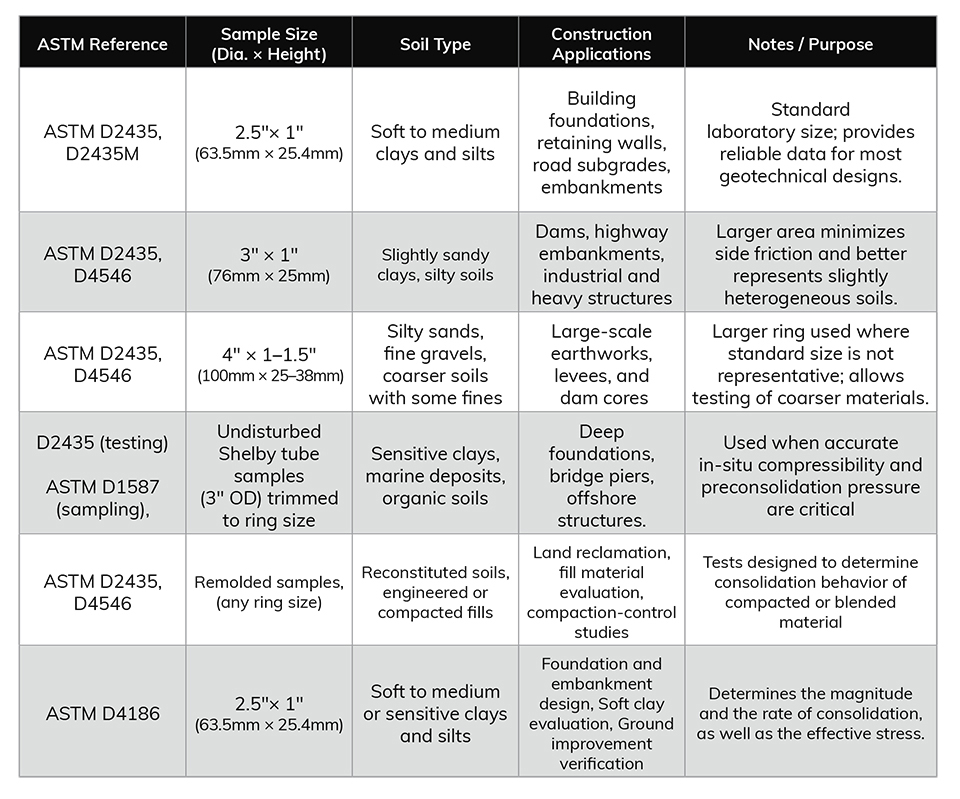
The standard sample size is 2.5” diameter × 1” thick, and is used for most building and geotechnical work. Larger samples, up to 4” dia., are used for coarse soils or major infrastructure (dams, levees, large embankments). Smaller or remolded samples are used for research or specific material characterization (engineered fills, controlled mixtures).
Table — Sample Sizes, Applications and Purpose of ASTM Tests
Humboldt Consolidation Machines
Humboldt provides an extensive offering of consolidation testing equipment to satisfy the needs of any soil testing laboratory. From our fully-automated ConMatic IMC machines to our pneumatic or dead-weight machines, we have soil consolidation testing covered.
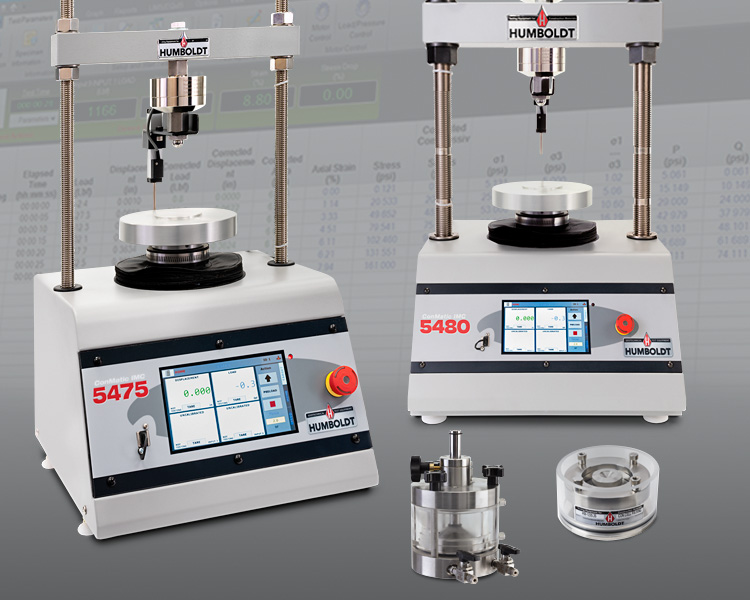
To ensure the best consolidation testing experience for your lab, we recommend Humboldt’s Electromechanical-Actuated Consolidation machines, the HM-5475 and HM-5480, which provide fully automated testing for performing incremental, Constant Rate of Strain (CRS), and Swell tests. The basic difference between these models is that the HM-5475 has a maximum load of 3300lbf (15kN), and the HM-5080 has a maximum load of 11240lbf (50kN). Both machines also include the NEXT Software Consolidation-Specific Module, as well as a Load Cell and Linear Strain Transducer, ensuring you get the correct equipment for your new setup.
One ConMatic IMC automated system can replace the production of several manual machines, freeing up technicians for other tasks. Once a sample has been placed onto the test platform and the test conditions set, the ConMatic IMC performs all consolidation tests, including moving to the next stress level, without operator assistance. The system automatically moves through the different test parameters specified by the user, with incremental consolidation tests typically being completed in 24 to 48 hours.