



Using a Continuous-Load Concrete Beam Breaker for Quality Control
- April 14th, 2026
- Category: Equipment Guides, Guest Posts
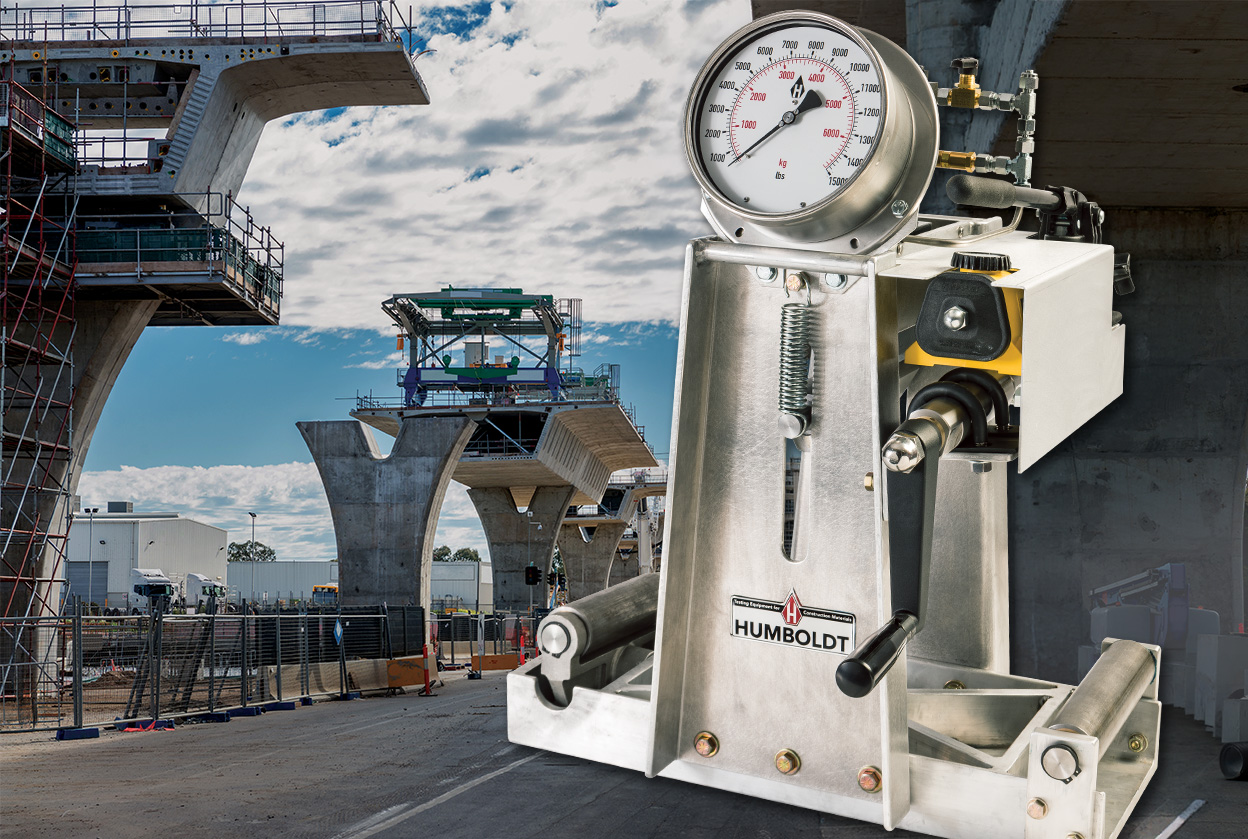
Continuous-Load Concrete Beam Breakers (also referred to as portable flexural beam testers are designed for use in concrete production facilities, such as precast plants, paving operations, and DOT spec work. These testers provide several advantages over the use of flexural compression machines and compression testing using test cylinders. One advantage of using continuous-load, beam breakers is that they are smaller and less expensive than typical concrete compression machines, making them ideal for placement near production, providing less handling of beams and faster results. Their portability also adds to their “ease-of-use”, allowing them to be easily moved to locations close to the operation.
A continuous-load beam breaker is designed to apply a steadily increasing (continuous) load to standard concrete beam specimens (4” or 6”) until the beam fails in bending. The key to test results is that these units use a continuous load through the test cycle. This continuous-load function is critical when used in QC test applications because it ensures test accuracy while ensuring a smooth and steady application of the load with every sample. The continuous-load design also provides compliance with industry standards. Continuous load also ensures accurate break-point detection, repeatable/comparable test results, and the elimination of operator-process variabilities.
Using Continuous-Load Beam Breakers as QC Instruments
The design of these beam breakers is perfect for use as real-time QC instruments. They can be used to validate mix design, confirming cement content, water-to-cement ratio, and admixture performance. Beam breakers can also detect mix irregularities, such as over-watering, poor aggregate gradation, inconsistent batching, and mix errors. Beam breakers provide for easy placement and use in field and plant operations because they are portable and lightweight. They also provide real-time feedback with Immediate pass/fail decisions, which enables rapid process correction. Beam breakers provide a fixed-span geometry, in either 1 or Third-point configurations, which eliminates setup variabilities. Their simple setup and operation require less operator knowledge and reduce testing errors due to operator variations. Unlike compression testing (cylinders), this measures flexural performance, which is often a more representative evaluation for real-world slab and pavement behavior.
Many applications require or desire flexural test evaluations rather than compressive strength, such as DOTs, especially in:
- Highway paving
- Airport slabs
- Bridge decks
The advantages of testing for flexural strength are:
- Better prediction of cracking resistance
- Better evaluation of service performance
- Provides a steady force via a hydraulic pump
- Measures maximum load at failure (modulus of rupture / flexural strength)
- Provides center-or third-point loading setup, adhering to Standards.
When used as a quality control function, continuous-load beam breakers can be used to:
- Determine the early-age strength of mixtures
- Determine when forms can be stripped
- Determine when to open pavement to traffic
When used to monitor construction and manufacturing processes, testing with beam breakers can:
- Aid in optimizing production-cycle times.
- Monitor and adjust process stability, reducing batch-to-batch variability.
- Control batch-to-batch variability.
- Provide monitoring and input for establishing and maintaining process calibration issues.
- Provide information and predictability of seasonal or temperature effects on processes and mixes.
State DOTs and The Use Of Continuous-Load Beam Breakers
Today, many State DOTs are using or evaluating the use of continuous-load beam breakers for form removal, opening roads and bridge decks to traffic, work acceptance, and pay factors. One such State DOT is the Illinois Dept of Transportation (IDOT), which is currently using beam breakers for work evaluations.
The process for DOTs is typically based on a specification they have designed. This spec usually defines a target, flexural strength (modulus of rupture, MR), which the concrete must meet for the type of work being done.
This specification will include required strength readings, such as:
- A required strength reading at a specific curing age, such as 7- or 14-day flexural strength (~600 – 750 psi).
- Required strength reading for opening a road section or bridge deck to traffic (~400 – 550 psi).
- The numbers, outlined in the spec. become the baseline acceptance threshold.
- Typically, the testing frequency will also be outlined in the spec. That typically looks like: One set of beams per X cubic yards (e.g., 500–1,000 CY), or per day’s production, or per paving lot. Each “set” of readings usually includes: 2–3 beams for each test age.
- Acceptance is rarely based on a single beam. Typically, 3-5 beams are used for each testing period. You will calculate the average flexural strength for all tested beams. Some specs require an evaluation of the lowest individual beam.
Typical outcomes for strength readings:
- If the average strength is ≥ than the specification, the test result is: Pass
- If the average strength is slightly < than the specification, the test result is: Pass with a pay reduction
- If the average strength is significantly < than the specification, the test result is: Remove/replace or investigate.
For Specifications that use beam breaker test results to establish Pay factors, beam breaker data becomes linked to financial profitability. In this type of specification, tests do not result in a simple pass/fail outcome; the strength test data is directly tied to project payment, construction scheduling, traffic-control costs, and project timelines.
Portable, Continuous-Load Beam Breakers Available From Humboldt
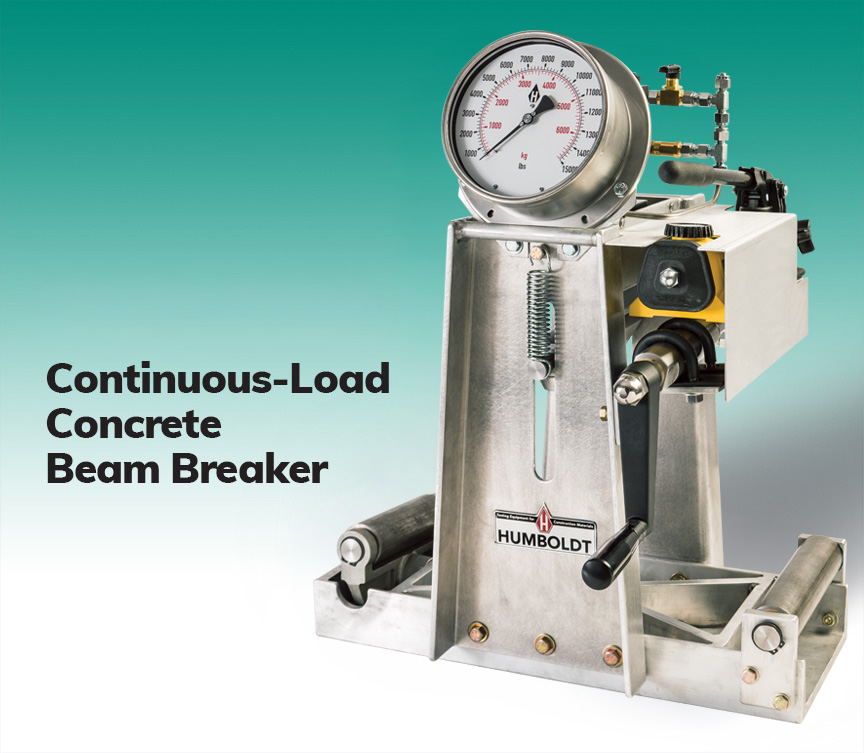
Humboldt‘s Portable, Concrete Beam Testers are a great quality control tool for contractors, DOTs, and consultants for quickly and accurately determining flexural strengths of concrete using 6" x 6" cross-section test beams. These Beam Breakers are hydraulically driven units that use the center-point loading method, providing continuous readings to the beam-breaking point while retaining the maximum reading for accuracy and eliminating lost data. The gauge also resets to zero for testing multiple beams. These beam breakers are constructed of lightweight aluminum, making them extremely portable for use at even the most remote of job sites. These models are self-contained, portable concrete beam testers, which accurately and easily determine flexural strengths of 6" x 6" test beams of 16" and 18" lengths.
These beam testers can be used as an accurate quality control tool to determine whether curing concrete has met a specified flexural strength. In this type of application, a known flexural strength value is determined and is used as a go/no-go test parameter. Numerous government agencies, including the Illinois DOT, have found its results acceptable for their purposes. Humboldt beam testers provide dual registration of modulus at rupture between 15,000 lbf. and 0 – 6,800 kgf. Each unit is calibrated by measuring the load applied on a calibrated load cell. The factory calibration is supplied at gauge readings of 10% FS, FS, as well as 3 readings in between. Three load cell readings are averaged for each point to determine the correction.
Humboldt provides four models of hydraulically-driven, continuous-load beam breakers. They are: